Navigate ComplexRegulatory Landscapeswith Confidence
Expert FMCG regulatory advisory services across the Middle East and North Africa. From market access strategy to product registration, we ensure your compliance success with over 25 years of proven expertise.
Trusted by FMCG Businesses Operating Across MENA
REGS Consultancy supports multinational FMCG companies, regional manufacturers, importers, distributors, and exporters with regulatory compliance, product registration, labelling review, and market-access strategy across the GCC and wider MENA region.
Regulatory advisory for global and regional FMCG businesses
Practical compliance support across GCC and MENA markets
Expertise in food, beverage, food-supplement and specialised-nutrition regulations
From Regulatory Uncertainty to Market Access
REGS Consultancy guides FMCG businesses through each stage of GCC and MENA market entry, from regulatory assessment and documentation readiness to product registration, labelling compliance, and post-launch regulatory monitoring.
- 1
Assess Requirements
- 2
Prepare Documentation
- 3
Review Labels & Claims
- 4
Support Registration
- 5
Maintain Compliance
Built for FMCG Businesses Entering Complex Markets
We support exporters, manufacturers, brand owners, importers, distributors, and private-label businesses operating across GCC and MENA markets.
Exporters
Manufacturers
Brand Owners
Importers
Distributors
Private Label Businesses
Comprehensive Regulatory Solutions
From strategy to implementation, we provide end-to-end regulatory services that ensure your FMCG products meet compliance requirements across the MENA region.
Market Access Strategy
Strategic regulatory roadmaps for food, beverages, food supplements, and infant formula market entry across MENA countries.
- Regulatory Assessment
- Market Analysis
- Entry Strategy
Regulatory Advocacy Services
Strategic advocacy and insights services that keep your business ahead of regulatory changes across MENA markets.
- Regulatory Insights
- Impact Assessment
- Authority Engagement
- Policy Position Papers
Product Registration & Regulatory Submissions
Complete end-to-end product registration and regulatory submission services for food, beverages, food supplements, and infant formula from dossier preparation to approval.
- Registration Process
- Regulatory Dossiers
- Authority Liaison
- Follow-up Support
Novel Food Approvals
Specialized expertise in novel food and additive approvals with scientific and regulatory support.
- Scientific Dossiers
- Safety Assessments
- Submission & Approval Strategy
Labeling Compliance
Food, beverage, food supplement, and infant formula label compliance across different MENA markets and languages.
- Label Review
- Nutrition & Health Claims
- Multi-language Support
Compliance Reviews
Comprehensive audits for food safety, beverage standards, food supplement, and infant formula compliance across MENA.
- Recipes Compliance
- Risk Assessment
- Corrective Action Plans
Proven Regulatory Expertise
A regional regulatory partner with deep category expertise and a track record of supporting compliant market entry across GCC and MENA.
25+ Years
Regulatory Experience
Decades of food & beverage FMCG regulatory advisory across GCC and MENA.
GCC & MENA
Market Coverage
Saudi Arabia, UAE, Qatar, Kuwait, Bahrain, Oman and wider MENA markets.
Food & Beverage
FMCG Expertise
Food, beverage, food-supplement and specialised-nutrition regulatory science, labelling review and product registration.
Multinational
& Regional Client Experience
Trusted by global food FMCG businesses and regional manufacturers and distributors.
Regulatory Insights & Market Updates
Practical perspectives on GCC and MENA regulatory compliance, product registration, labelling requirements, and market-access developments for FMCG businesses.
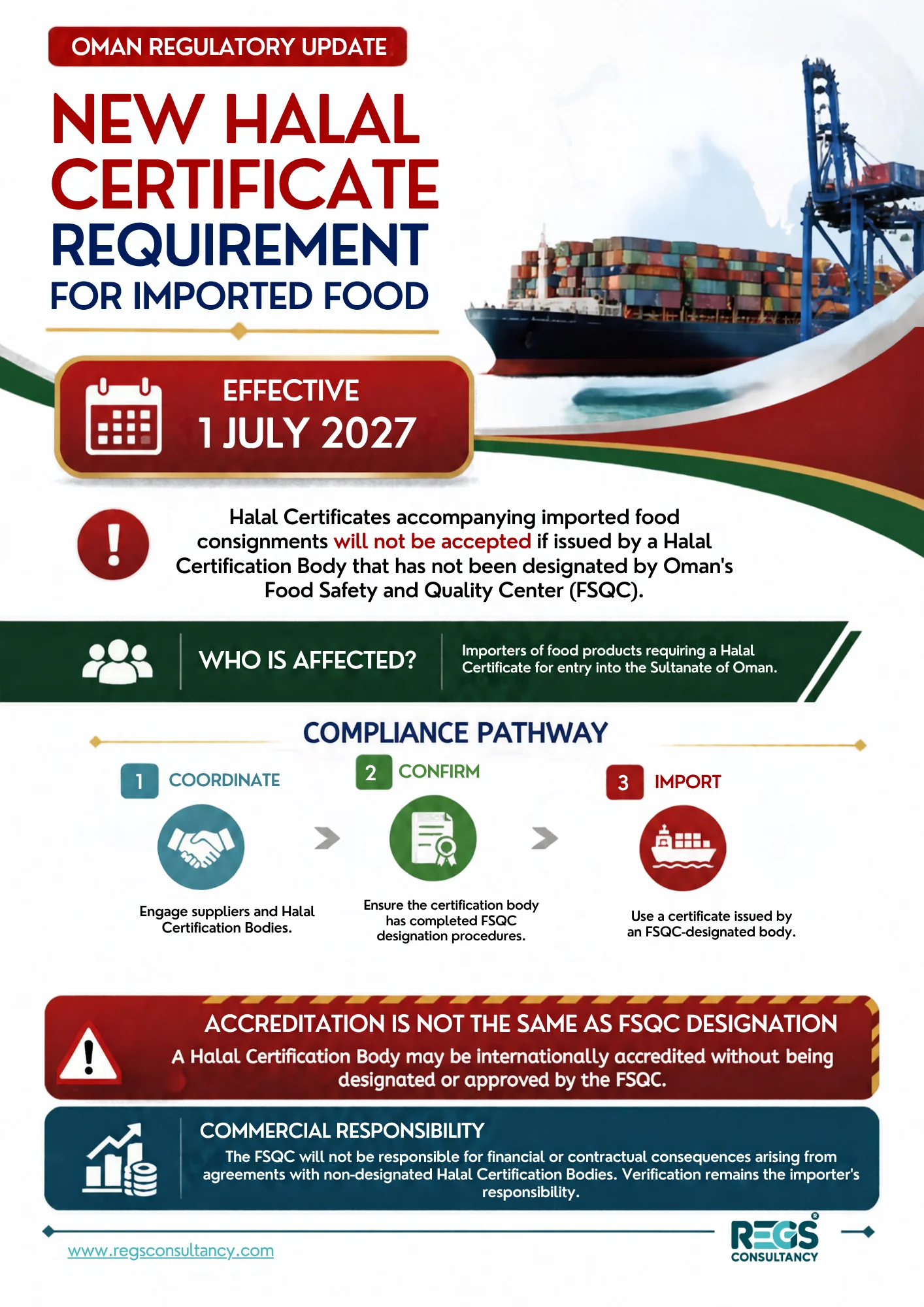
Oman to Reject Halal Certificates from Non-FSQC-Designated Bodies from 1 July 2027
Oman's Food Safety and Quality Center (FSQC) has announced that, from 1 July 2027, Halal Certificates accompanying imported food consignments will not be accepted if issued by a Halal Certification Body that has not been designated by the Center. Importers must verify their certification bodies' designation status before contracting.
Ready to Enter GCC & MENA Markets with Confidence?
Partner with a specialist FMCG regulatory consultancy for product registration, labelling review, and market-access strategy across GCC and MENA.