Qatar MOPH Issues Updated Guide on Health and Nutrition Claims for Food Products
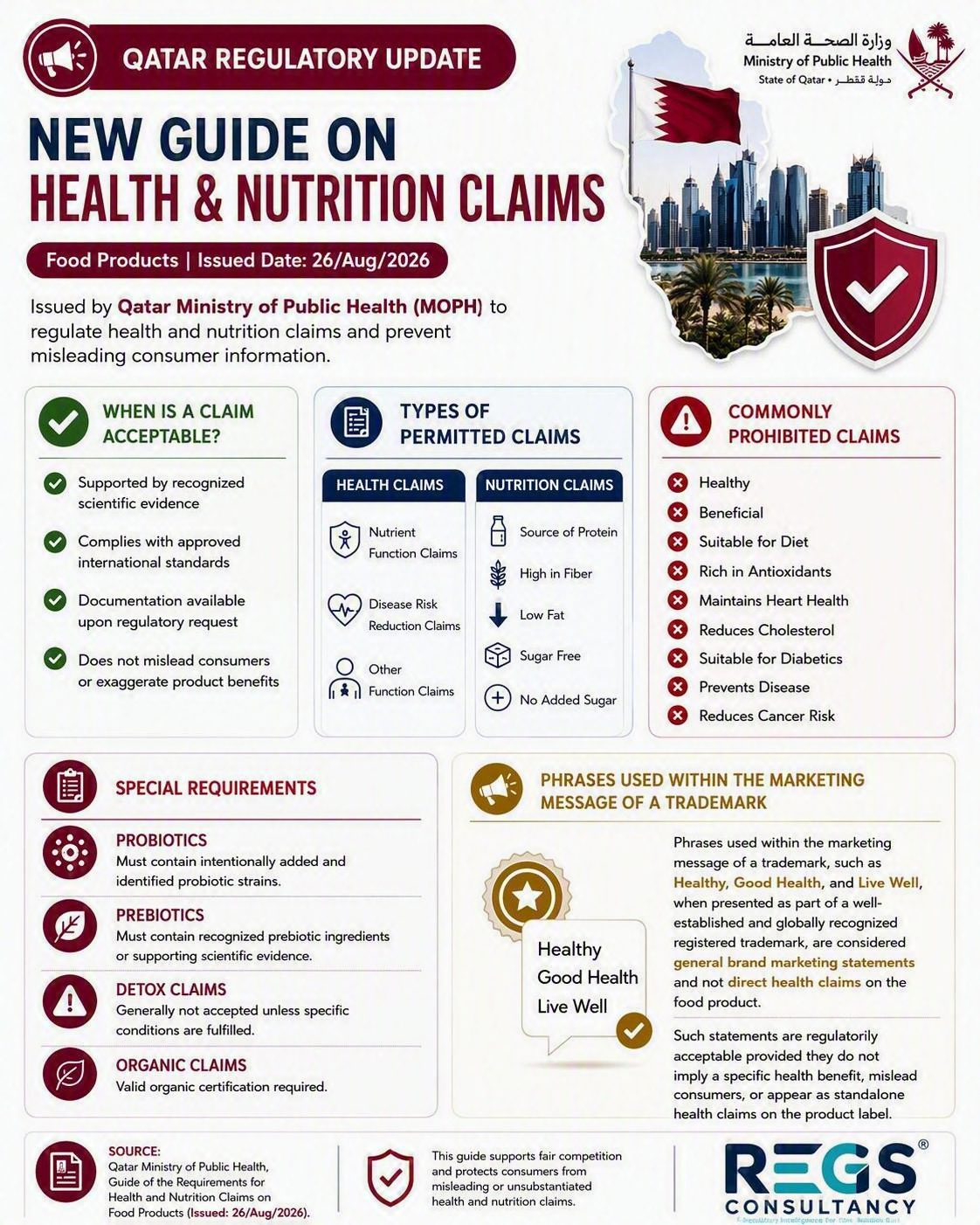
Qatar's Ministry of Public Health has issued Edition V2/2026 of its Guide of the Requirements for Health and Nutrition Claims on Food Products, clarifying which health and nutrition claims are acceptable, listing commonly prohibited claims by product category, and setting new compositional thresholds for nutrient claims, probiotics, prebiotics, DETOX and organic labelling.
Doha — August 2026
Qatar's Ministry of Public Health (MOPH), through its Food Safety Department, has issued Edition V2/2026 of the Guide of the Requirements for Health and Nutrition Claims on Food Products, dated 26 August 2026. The guide is based on national technical regulations and standards and on Gulf Technical Regulation GSO 2333:2022, and sets out in detail which health and nutrition claims may be used on food labels in Qatar, which claims are commonly prohibited, and the additional evidence required for specific claim types such as probiotics, prebiotics, DETOX and organic.
Why the Update Matters
Health and nutrition claims are among the most influential factors in a consumer's purchase decision, which is why MOPH continues to tighten oversight of how food and beverage brands describe their products. The guide reiterates a core principle: any claim that could mislead or deceive the consumer, overstate a benefit, or create a false impression about a product's health value is prohibited, regardless of how the claim is worded.
Health Claims vs. Nutrition Claims
The guide distinguishes between two broad categories:
- Health claims — any statement suggesting a relationship between a food (or its constituent) and health. These include nutrient function claims (the role of a nutrient in growth, development or normal body function), disease risk reduction claims, and other function claims describing a positive contribution to health or bodily function.
- Nutrition claims — statements about a food's nutritional properties, including nutrient claims (e.g. energy, protein, fat, carbohydrate or vitamin/mineral content) and nutrient content claims (e.g. "source of calcium," "high in fiber and low in fat").
When Is a Claim Acceptable?
Under the guide, a health or nutrition claim is only acceptable where it has been substantiated by internationally recognized scientific bodies, with supporting documentation available on request from the competent authority. Examples of claims the guide considers permissible include:
- General, scientifically proven statements about the effect of vitamins and minerals added to or naturally present in a food, provided the description is generic and not tied to the brand.
- General, scientifically proven statements about an ingredient's effect — for example, describing tea, coffee or energy drinks as having a refreshing effect due to caffeine content — again provided the description is generic and not brand-specific.
- General, scientifically proven statements about a food's own health benefits, such as describing canola oil as a healthy oil, provided the description applies to that type of food generally rather than to a specific brand.
- Marketing phrases used as part of a well-established, globally recognized registered trademark (see below), where they function as brand identity rather than a direct health claim.
Claims That Remain Prohibited
The guide provides an extensive, product-by-product list of claims that MOPH considers commonly used but unacceptable. Illustrative examples include:
- Green tea: "dissolves cholesterol," "burns fat," "helps achieve an ideal weight."
- Honey and honey products: "strengthens immunity," "treats erectile dysfunction," "prevents cancer," "an alternative to sugar."
- Vegetable oils: "free of cholesterol," "maintains a healthy heart," unsubstantiated "rich in omega-3" claims.
- Coffee and tea: "strengthens concentration," "cleanses the body of toxins," "increases body vitality."
- Milk and dairy products: "helps strengthen bones," "suitable for diet," "gives your child what they need."
- Mineral or sparkling water and corn flakes: general wellness claims such as "healthy," "beneficial," or "helps lower blood sugar."
Beyond specific product examples, the guide also lists broad wording patterns that are prohibited across all food categories regardless of the product — phrases built around verbs such as "prevents," "reduces the risk of," "treats," "cures," "boosts," "detoxifies," "repairs," or "restores," and descriptors such as "suitable for diabetics," "rich in antioxidants," and "suitable for diet." Businesses should treat this as a checklist to screen packaging copy and marketing claims before finalizing artwork.
New Compositional Thresholds for Nutrition Claims
The guide sets out specific compositional criteria that must be met before a nutrition claim can be used, including:
- Source of protein: at least 12% of total energy value; high/rich in protein: at least 20%.
- Source of fiber: at least 3g/100g (or 1.5g/100ml); high in fiber: at least 6g/100g (or 3g/100ml).
- Low fat: no more than 3g/100g solid or 1.5g/100ml liquid; fat free: no more than 0.5g/100g or ml (claims phrased as "X% fat-free" are prohibited).
- Cholesterol-free / low cholesterol: subject to strict limits on both cholesterol and saturated fat content — the "cholesterol-free" claim is specifically prohibited on vegetable oils and their products.
- Low sugar: no more than 5g/100g or 2.5g/100ml; sugar free: no more than 0.5g/100g or ml.
- No added sugar: permitted only where no sugars or sweeteners have been added, with the label stating "contains naturally occurring sugars" where relevant.
- Keto: total carbohydrates no more than 8g/100g, or net carbohydrates no more than 8g/100g with the calculation method declared on the nutrition label.
Probiotics, Prebiotics, DETOX and Organic Claims
The guide introduces additional substantiation requirements for several claim types that are frequently used but often unsupported:
- Probiotic claims require the ingredient list to name intentionally added bacterial strains, identified at strain level with known origin — naturally occurring bacteria from processing or raw materials do not qualify.
- Prebiotic claims require a recognized prebiotic substance in the ingredient list (such as oligosaccharides, inulin and fructo-oligosaccharides, galacto-oligosaccharides, resistant starch, pectin, or cocoa-derived flavanols), or a scientific study demonstrating the substance's role in stimulating beneficial bacteria.
- The claim "beneficial for digestive health" is only accepted where beneficial bacteria have been intentionally added to the product.
- DETOX is not accepted as a health claim unless the Arabic term used clearly does not imply "removing toxins," the English word is qualified by phrases that make clear no toxin removal is implied (e.g. "Water with Mint"), or supporting scientific evidence is provided.
- Organic claims must be supported by a valid, recognized organic certification.
Trademark and Brand Marketing Phrases
The guide clarifies that phrases such as "Healthy," "Good Health," and "Live Well," when used as part of a well-established and globally recognized registered trademark, are treated as general brand marketing statements rather than direct health claims — citing examples such as "To Your Good Health" (Bob's Red Mill), "Good food, good life" (Nestlé), "Nourish Your Day" (Kellogg's), "For a better you" (Alpro), and "Fuel your day the healthy way" (Weetabix). This treatment applies only where the phrase does not imply a specific health benefit, mislead consumers, or stand alone as a health claim on the product label. Trademarks implying a direct health or therapeutic claim — such as "Miracle Honey" or "Healing Honey" — remain unacceptable, with narrow exceptions for globally recognized dual-meaning trademarks and traditional honey names that do not suggest a specific health benefit.
What Food Businesses Should Do Now
- Audit existing claims: Screen current packaging, marketing and e-commerce content against the guide's lists of acceptable and prohibited claims and wording patterns.
- Build an evidence file: Assemble the scientific and technical documentation needed to substantiate any health or nutrition claim before it is used, so it is ready if requested by the regulator.
- Review formulations against thresholds: Confirm that products carrying claims such as "high in fiber," "low fat," "sugar free" or "keto" meet the specific compositional limits in the guide.
- Check probiotic and prebiotic labelling: Ensure ingredient lists correctly identify added strains or recognized prebiotic substances where these claims are used.
- Reassess trademark-based marketing lines: Confirm that any "Healthy"/"Good Health"/"Live Well"-style phrases are tied to a genuinely registered, well-established trademark, and do not function as a standalone health claim.
How REGS Consultancy Supports Compliance
REGS Consultancy advises food and beverage brands on regulatory readiness across Qatar and the wider GCC. For this update, we support clients with claims audits against the MOPH guide, evidence dossier preparation for health and nutrition claims, label and artwork review, and formulation checks against the new compositional thresholds — so that products on the Qatari market are fully compliant ahead of enforcement checks.
Related Insights
UAE Introduces Tiered Sugar Tax System for Sweetened Beverages
The UAE Ministry of Finance and Federal Tax Authority have announced a revolutionary amendment to excise tax on sugar sweetened beverages, introducing a tiered volumetric model that directly links tax value to sugar content per 100ml.
Oman to Reject Halal Certificates from Non-FSQC-Designated Bodies from 1 July 2027
Oman's Food Safety and Quality Center (FSQC) has announced that, from 1 July 2027, Halal Certificates accompanying imported food consignments will not be accepted if issued by a Halal Certification Body that has not been designated by the Center. Importers must verify their certification bodies' designation status before contracting.