Oman Introduces Licensing for Specialized Food Categories
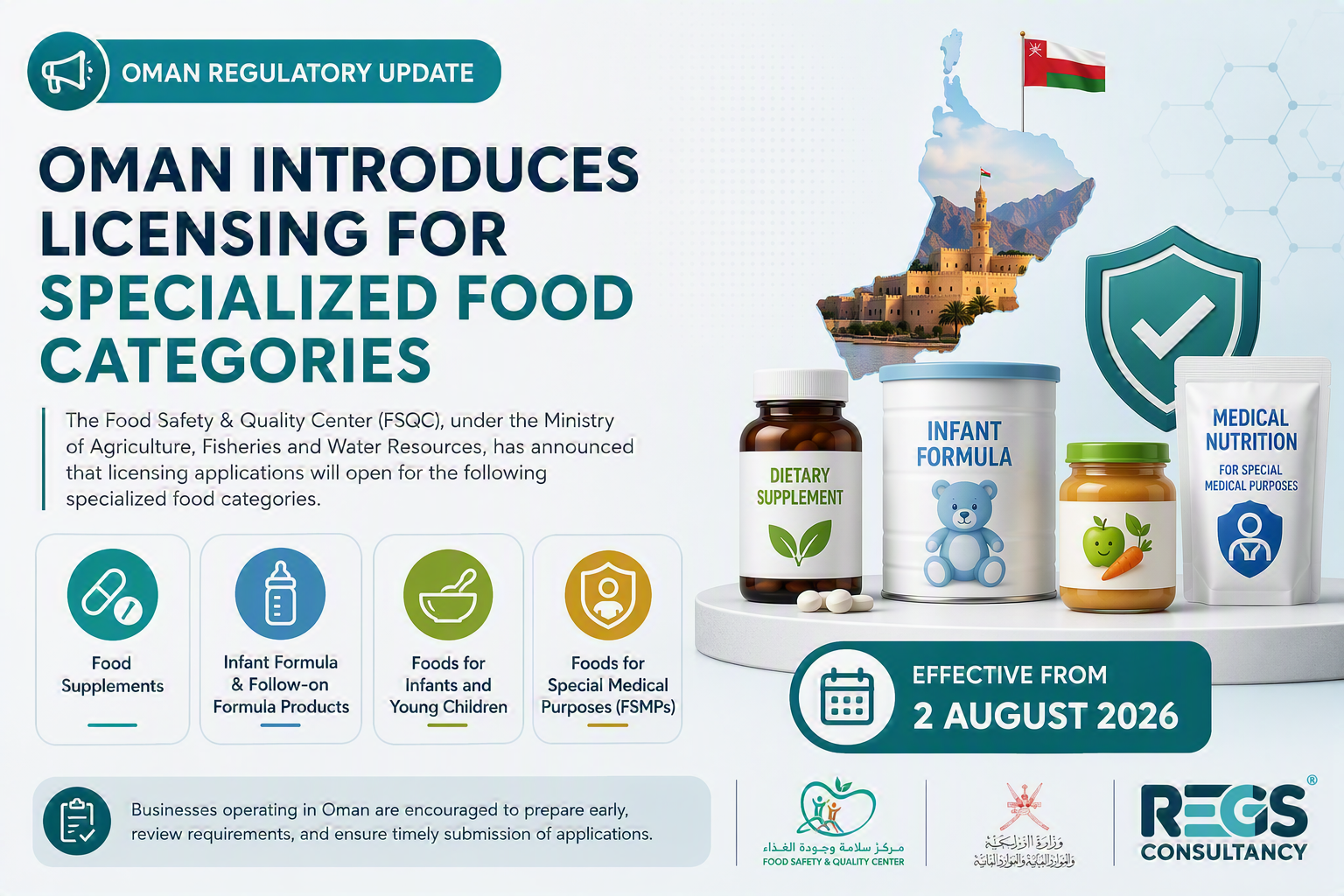
Oman's Food Safety & Quality Center (FSQC), under the Ministry of Agriculture, Fisheries and Water Resources, will open licensing applications for food supplements, infant formula and follow-on formula, foods for infants and young children, and foods for special medical purposes (FSMPs) — effective 2 August 2026.
Muscat — July 2026
The Food Safety & Quality Center (FSQC), operating under the Ministry of Agriculture, Fisheries and Water Resources of the Sultanate of Oman, has announced that licensing applications will officially open for four specialized food categories. The new licensing regime becomes effective on 2 August 2026 and marks a significant step in aligning Oman's food safety oversight with international best practice for sensitive product categories.
Categories Covered by the New Licensing Regime
The FSQC announcement confirms that licensing applications will be accepted for the following specialized food categories:
- Food Supplements — including vitamins, minerals, and other dietary supplement products intended to complement the normal diet.
- Infant Formula & Follow-on Formula Products — breast-milk substitute products intended for infants during the first months of life and follow-on products for older infants.
- Foods for Infants and Young Children — complementary and processed baby foods intended for infants and young children.
- Foods for Special Medical Purposes (FSMPs) — specially formulated foods for the dietary management of patients under medical supervision.
Why This Matters
These four categories are among the most tightly regulated food groups worldwide because they are consumed by vulnerable populations — infants, young children, and patients with specific medical conditions. Introducing a dedicated licensing pathway allows the FSQC to:
- Verify the composition, safety, and labelling of specialized products before they reach the Omani market.
- Ensure alignment with Gulf and international standards, including relevant GSO technical regulations and Codex Alimentarius guidance.
- Strengthen consumer protection through pre-market authorization rather than only post-market surveillance.
- Improve traceability of manufacturers, importers, and distributors handling sensitive product categories.
Effective Date and Transition
The new licensing framework enters into force on 2 August 2026. From that date, businesses placing food supplements, infant formula, complementary foods for infants and young children, or foods for special medical purposes on the Omani market are expected to submit their applications through the FSQC's official channels.
The Center has encouraged businesses operating in Oman to prepare early, review the applicable requirements, and ensure timely submission of applications to avoid disruption to product availability in the local market.
What Businesses Should Do Now
Manufacturers, importers, and distributors targeting the Omani market should begin readiness activities immediately. Practical steps include:
- Product portfolio review: Identify all SKUs that fall within the four specialized categories and confirm their intended classification.
- Technical dossier assembly: Compile ingredient specifications, nutritional composition, manufacturing details, stability data, and safety documentation for each product.
- Label and claim audit: Verify that packaging, mandatory statements, warnings, and any nutrition or health claims are consistent with Oman and GCC requirements for the relevant category.
- Certificates and supporting documents: Prepare free sale, health, halal, and manufacturing certificates as required by the FSQC.
- Supply chain readiness: Align with local agents and distributors on responsibilities for submission, storage, and post-market obligations.
Regional Context
Oman's move reflects a broader GCC trend toward stricter oversight of specialized food categories, following comparable frameworks already in place across neighbouring markets. For multinational FMCG and nutrition brands, harmonising documentation across Saudi Arabia, the UAE, Kuwait, Qatar, Bahrain, and now Oman is an increasingly important part of any regional market-access strategy.
How REGS Consultancy Supports Compliance
REGS Consultancy advises food, beverage, and nutrition brands on end-to-end regulatory readiness across GCC and MENA markets. For the new Oman licensing regime, we support clients with category classification, dossier preparation, labelling and claims review, and coordination with local partners so that applications are ready well ahead of the 2 August 2026 effective date.
Related Insights
UAE Introduces Tiered Sugar Tax System for Sweetened Beverages
The UAE Ministry of Finance and Federal Tax Authority have announced a revolutionary amendment to excise tax on sugar sweetened beverages, introducing a tiered volumetric model that directly links tax value to sugar content per 100ml.
Jordan Prohibits Specified Smoke-Flavouring Primary Products
Jordan's Food and Drug Administration has prohibited the import and use of eight specified smoke-flavouring primary products, cancelled existing import approvals, and set transition deadlines of 31 December 2026 for general foods and 31 December 2029 for specified cheese, meat and fish products.